Clarinet Mouthpieces 101
There is a lot of conflicting information when it comes to clarinet mouthpieces and what the function of a given facing does or does not do for the player. The information that I am about to present are general concepts and should be taken with a grain of salt. Each mouthpiece and the material it is made of presents differently. I’m going to start by just defining some terms because it will help in the totality of understanding and the combinations.
Blanks
Typically when someone references a mouthpiece blank, what they are referring to is the bulk unfinished production of a mouthpiece. Perhaps the most well known blank in the history of clarinet is the Zinner blank. Most custom mouthpiece makers had some variation of a Zinner blank mouthpiece until they ceased production in the mid 2010’s. What this means is that the mouthpiece “blanks” that would arrive to various makers would be the same (or one of a few variations), and then the maker would finish it with a facing. Speaking of…
Facing
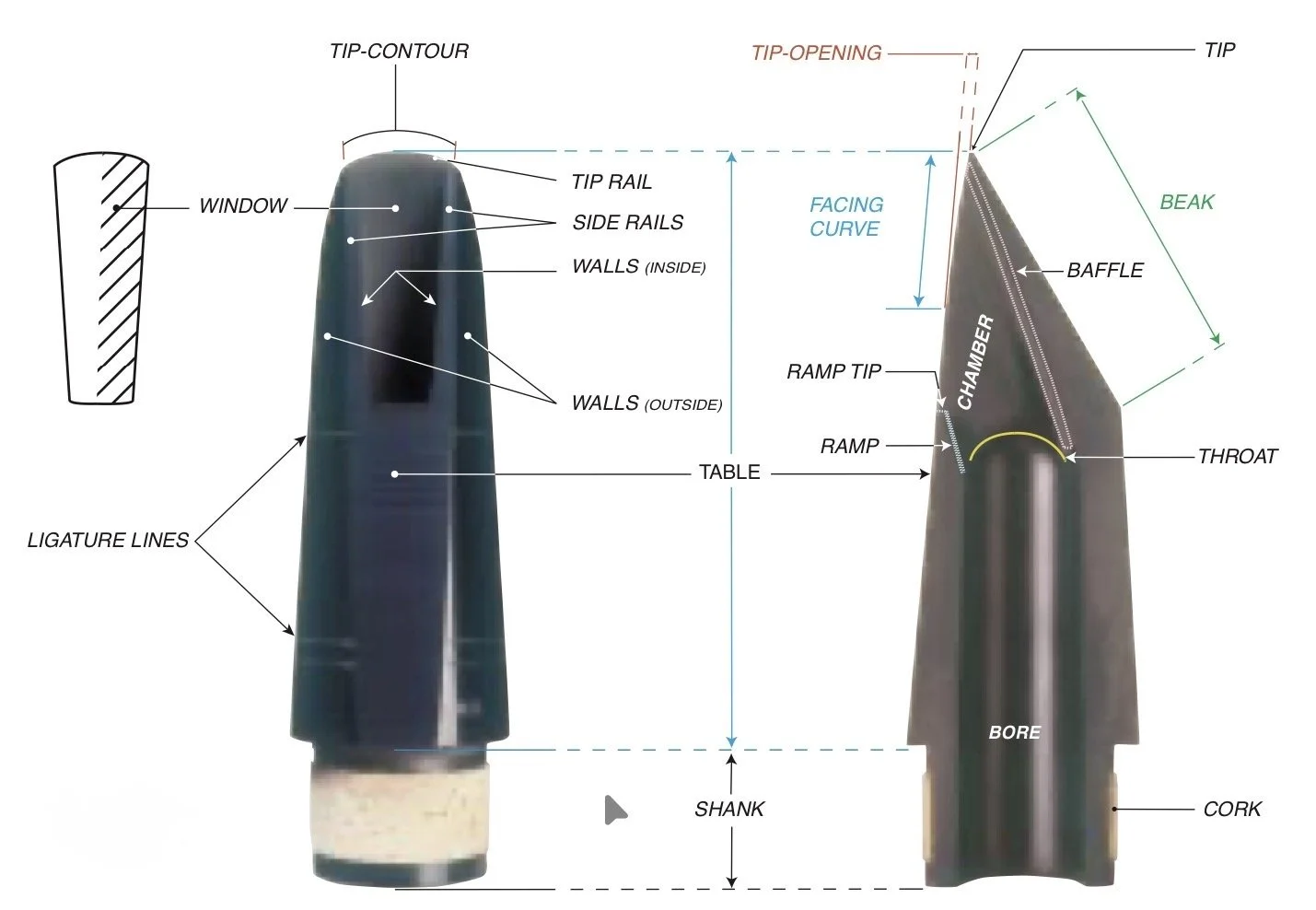
The facing of a mouthpiece considers many different factors. In my opinion, the two most consequential elements are the length and the tip opening. The length of the facing refers to the distance between the tip and the point where the reed hits the mouthpiece and ceases vibration. The tip opening refers to exactly what it says, the distance between the tip of the reed and the tip of the mouthpiece. These two metrics are used in tandem to create different experiences for the player
Tip Opening
Tip openings can range between 1.00mm to as wide as 1.50mm and even larger for particular jazz pieces. Most classical mouthpieces land within the 1.00 to 1.20 range. In general, the closer the tip opening, the easier it is for a reed to vibrate. Consequently, if you have a closer tip opening, you generally will need a harder reed than that of a more open tipped mouthpiece. Mouthpieces with a closer tip tend to have a very focused sound with easy articulation and more immediate back pressure. Open tipped mouthpieces are generally more free blowing, flexible, and can create a larger sound/resonance, but require significantly more air and embouchure strength to control because of the back pressure further down the system.
Length
The length of a facing is used in conjunction with the tip opening to create different sensations with the player. In general, the longer the facing, the harder the reed that is needed and the shorter the facing, the softer the reed that is needed. Think of it this way; with shorter facings, less of the length of the reed is vibrating, thus a softer reed, and with a longer facing, more of the reed is vibrating, thus a harder reed.
Pitch
You will see some mouthpieces advertised as “American” Pitch 440 or “European” Pitch 442. Vandoren calls their 440 mouthpieces “13 Series”. While it is true that the 442 mouthpieces will be higher in pitch, they also are fundamentally different pieces. In general, 440 mouthpieces tend to be slightly more resistant, darker and wider in sound than their 442 counterpart. Consequently, 440 mouthpieces also tend to respond a little more sluggishly than their 442 counterpart. This is due to the fact that the difference in pitch is accounted for by a different cubic volume inside the chamber of the mouthpiece.
The difference in pitch, however, is not entirely proportional. Yes, in general, the 442 mouthpiece will play higher, but please know that the throat tones and left hand notes will be disproportionately affected. The same is true for the 440 mouthpieces, where the left hand tends to ride on the low side, particularly in the throat tones and chalumeau register (E, F, F#). Ensure that you have an appropriate barrel length and taper to compensate for these differences. Typically, plan on using a 1mm longer barrel for a mouthpiece advertised at 442 than you would for a 440 mouthpiece.
Other Factors
As you can see in the chart to the left, there are other aspects of a mouthpiece that a maker can adjust to create a different experience for a player. For example, a baffle that is more scooped or hollowed out creates a more cushioned response and a darker sound, vs a straighter more angular baffle will be brighter and more direct. Thinner tip rails and side rails leads to a mouthpiece with more immediate response. Companies and custom makers can tweak these different elements which is then balanced by a reed cut, strength and ligature choice.
Recap
This is certainly not an exhaustive list of what affects a mouthpiece, but it will at least give you a general idea of what to look for and what various measurements mean in terms of a real world playing experience. The goal of this article is for the next time you see a mouthpiece chart with a bunch of numbers and jargon, that you will have an idea of what that means for you.
The more I’ve experienced different types of equipment, the more I’ve realized that everything works together in a single ecosystem. The mouthpiece is perhaps the perfect example. If you have a mouthpiece with a long facing and close tip, you are going to need a pretty stiff reed to achieve desired sound quality. If you have a medium facing in combination with an open tip, a softer reed will work much better. These differences travel down the instrument in different capacities. If you ever want to experience this for yourself, find a trusted colleague who plays on a completely different setup than you. Try your mouthpiece and reed on both their instrument and your instrument, and then try their mouthpiece and reed on both your instrument and their instrument. A perfect setup is all about balance and choosing where you want the good resistance. You can place resistance in the reed, mouthpiece, ligature, barrel, bell, or clarinet. It all comes down to personal preference and what you find most consistent in the environment that you play in the most. Unfortunately, there is no right or wrong answer, but I hope this guide at least helps you move closer to your “Goldilocks” setup. I’m still searching myself!